Does your business need a page for every service and town?
You don’t need a page for every town you cover. Start by explaining your main services and where you work. Add a separate page when customers need details you haven’t already covered.
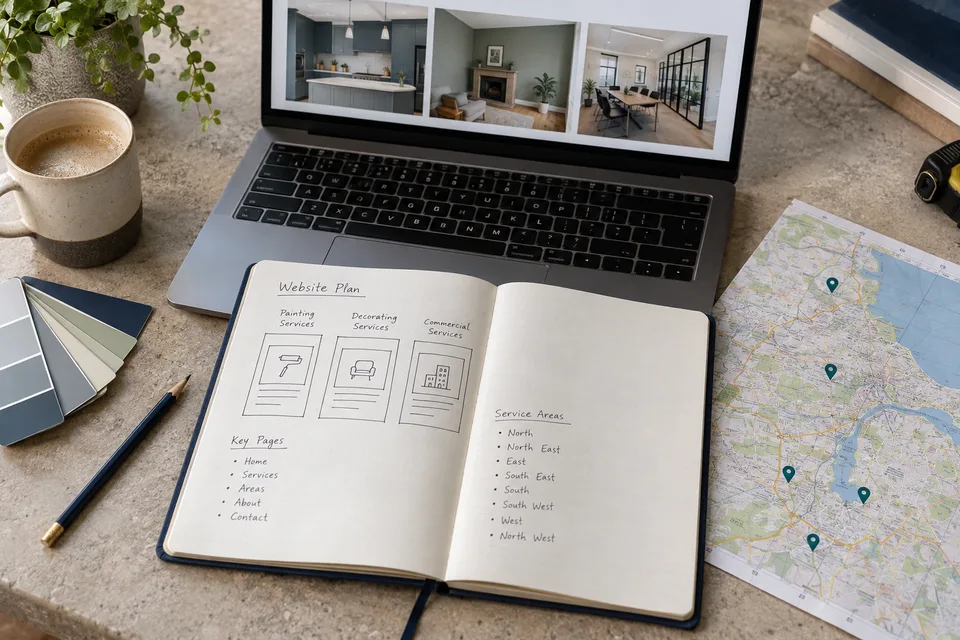
Explain the services customers are looking for
Your homepage introduces your business. A service page lets you explain a particular job in more detail, so someone can work out whether you’re the right company to contact.
Consider a decorating firm offering interior painting, kitchen cabinet painting and commercial redecoration. A homeowner asking about kitchen finishes has different questions from a facilities manager planning work around occupied offices. Putting everything into one short list makes those differences harder to explain.
A separate page can cover the relevant preparation, project types, working arrangements and information needed for a quote. It is useful even when the visitor arrives through a referral or an email rather than Google. See what customers check online before choosing a business.
Do not create separate pages just for alternative names for the same service. If the offer, examples and customer questions are effectively identical, one clear page may do the job.
A town name is not enough to justify another page
Start by making your coverage clear on the pages you already have. A customer should be able to tell whether you travel to their area and whether any restrictions apply.
A dedicated area page may be useful when you can explain something meaningful about working there: relevant projects, services available locally, travel arrangements or the types of premises you support. Only use details that are true. Do not imply you have a local office where you do not.
Try reading the page without the town name. Does it tell customers anything different from your other pages? If it doesn’t, you may only need a clearer explanation of your coverage.
Google advises creating content for the people you serve, with original value rather than mass-producing pages mainly to attract search visits. It also says it has no preferred word count. That supports a useful-page approach, not a target of hundreds of town pages. Google’s people-first content guidance.
What this could look like for a decorating business
Illustrative example, not a client case study. A small decorating team wants more kitchen work and occasional office projects within a manageable travelling distance.
- Homepage: introduce the team, main services and area covered.
- Kitchen painting page: explain suitable surfaces, assessment, preparation and the quotation process, supported by genuine kitchen photographs.
- Commercial decorating page: explain premises served, access arrangements and how the team discusses disruption and scheduling.
- Coverage section: name the places the team genuinely serves, without implying separate branches.
- Project story: describe an actual job with permission to use the photographs and customer details.
A separate town page comes later if it adds information a customer would use. This is a starting structure, not a rule that every decorator needs these exact pages.
What belongs on a useful service page?
- The work you offer. Be specific about what is included and what you do not take on.
- Who it suits. Explain whether you work with homeowners, landlords, businesses or other contractors.
- Evidence people can check. Use your own relevant projects, accurate credentials and genuine feedback. Label illustrative imagery rather than presenting it as completed work.
- Your process. Tell the reader what happens after an enquiry, including any survey or assessment needed before a quote.
- Your coverage. Explain where you work in ordinary language.
- A clear next step. Ask for the details that help you assess the enquiry, not a long form full of information you do not need yet.
Link to these pages from your services overview and from relevant guides or project stories. Someone should not need a search engine to find an important service on your own website.
For the information to collect after someone contacts you, see how to qualify a lead.
Help customers work out whether your service fits.
Explain the work, show relevant examples and make it easy to enquire. You can leave out extra pages that repeat the same information.
How does this fit with SEO and AI search?
SEO means improving how search engines can find and understand your website. AEO, often called answer engine optimisation, describes work intended to make information useful in answer-led search experiences. Neither is a reason to fill a page with repeated phrases.
For Google’s AI Overviews and AI Mode, Google says the existing SEO foundations still apply. It does not require special AI files or special structured data. A page must be indexed and eligible for a search snippet to appear as a supporting link, and appearance is not guaranteed. These are Google’s requirements, not a promise about every chatbot. Google’s guidance on AI search features.
Our recommendation is to answer real customer questions directly, keep service details accurate and make the next step obvious. Do not promise that a new page will make an AI tool recommend the business.
Choose one page to improve first
Write down the work you want more of, the questions customers ask before buying and the evidence you can share. Then compare that list with your website. Start with a service you want more enquiries for that your website doesn’t explain well.
Improve that page before commissioning a large batch. Ask someone unfamiliar with the business whether they can identify the service, area, evidence and next step without help.
After publication, review relevant search queries and page visits alongside enquiries. Record whether those enquiries match your services and coverage, then follow their progress to quotes and booked work where data exists. A larger number of pages or impressions alone does not show commercial value.
Before deleting or replacing existing pages, check their links and performance and plan any necessary redirects. This guide is a planning exercise, not a reason to remove pages that already help customers.
Common questions
Can I mention several towns on one page?
Yes. A clear, accurate coverage section can be more useful than several near-identical pages. Explain where you actually work; do not turn the paragraph into a long list of search phrases.
Is repeating my service name bad?
Using the same service name naturally across your website is normal. The issue to avoid is unnecessary repetition or pages that give customers no additional useful information. You do not need a new synonym in every paragraph.
Do I need an FAQ on every page?
No. Add questions where they resolve genuine uncertainty. If the main page already answers them clearly, repeating the same answers in an FAQ adds little.
Should I create every service-and-town combination?
Not by default. Start with the services and areas you can support properly. Add pages selectively when the customer need and available information justify them.
Make your website reflect the work you want
InstallsUp helps trade and service businesses plan and improve their search presence around the services, customers and areas that matter. We can help you decide what needs a dedicated page and what is better explained on an existing one.
See how our SEO service works